
Commercial EICR and Fixed Wire Testing: A Practical Planning Guide for Facilities Managers and Landlords

If you are responsible for an occupied building, mixed-use property or wider estate, commercial EICR fixed wire testing should be planned, not left until a certificate is overdue or a fault disrupts day-to-day operations. For facilities managers and landlords, a well-organised inspection helps you understand the condition of the installation, manage disruption more effectively and prioritise any remedial work with clearer budgeting.
At SGE-Services Ltd, we support commercial, industrial and large-scale development projects across South London, Surrey, Hampshire, Berkshire, Sussex and Kent with inspection, testing, maintenance and repairs. From our Merstham, Redhill base, we help clients take a practical approach to electrical safety and ongoing compliance.
What commercial EICR and fixed wire testing actually means
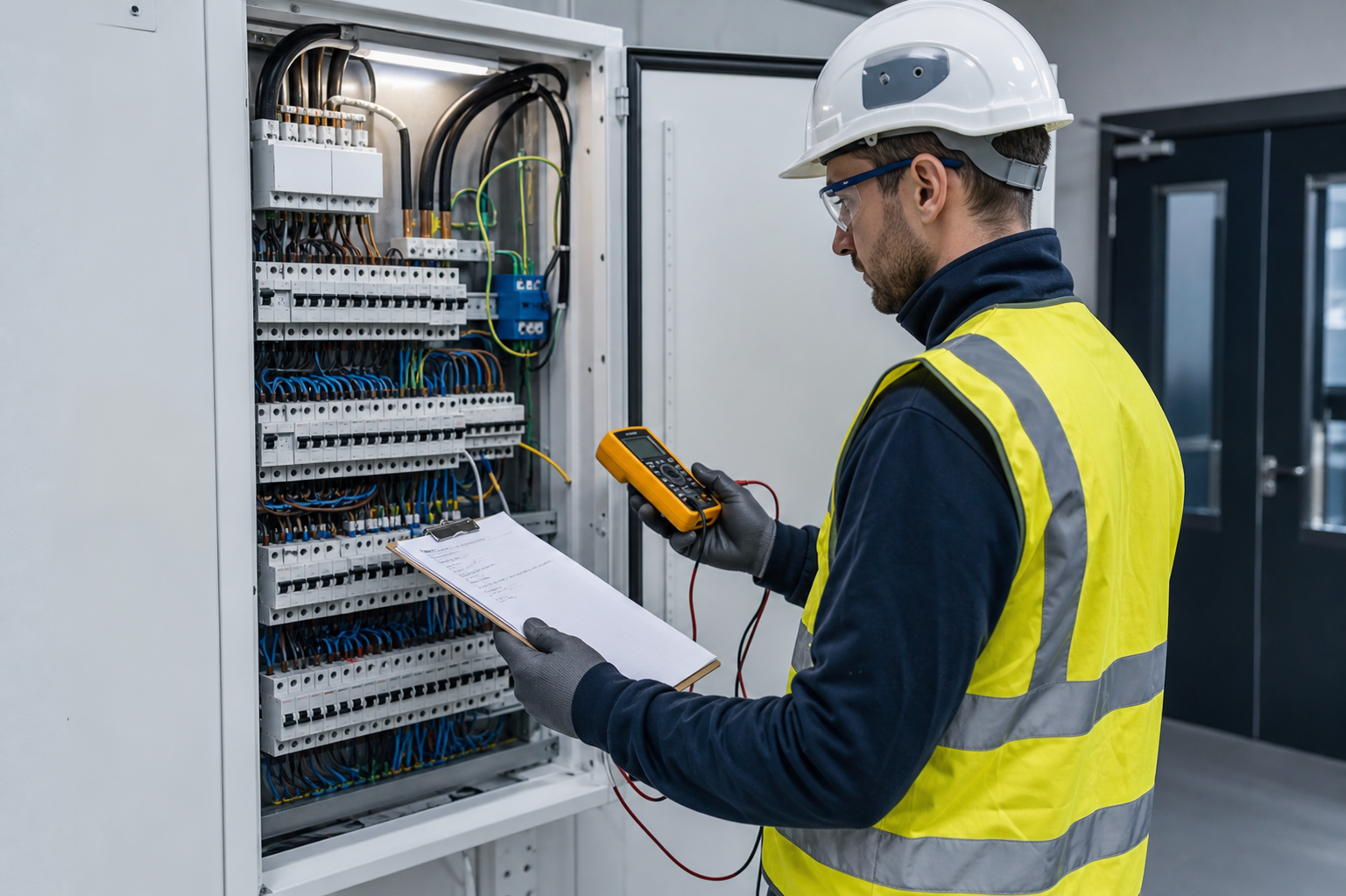
Fixed wire testing is the term many property professionals use for the inspection and testing of a building’s fixed electrical installation. The formal report produced is usually an Electrical Installation Condition Report, or EICR.
In simple terms, the inspection looks at the condition of the electrical installation and whether it appears suitable for continued use. That can include items such as distribution boards, protective devices, circuits, earthing, bonding and associated electrical accessories.
It is different from portable appliance testing. PAT covers plug-in items such as kettles, monitors and extension leads. A commercial EICR focuses on the fixed installation that powers the building.
Why planning matters in commercial buildings
Commercial premises are rarely straightforward testing environments. Access may depend on tenants, security procedures, production schedules, cleaning teams, plant shutdowns or out-of-hours working. In multi-let buildings, one delayed area can affect the whole programme.
Good planning helps you:
reduce avoidable disruption to staff, tenants and visitors
identify where temporary power loss may affect operations
allow for safe access to risers, plant rooms and locked areas
budget for likely remedial works after the report
phase testing sensibly across multiple sites or units
For landlords, this also makes communication with managing agents and occupiers far easier. For facilities managers, it gives a clearer path from survey to report to remedials, instead of treating each step as a separate problem.
How to plan commercial EICR fixed wire testing
1. Define the scope before dates are booked
Start with the basics. Are you arranging testing for a single unit, common parts only, a full building or a portfolio of sites? Are there tenant demises, storage areas, external supplies or plant areas that need to be included?
It also helps to note any known issues in advance, such as nuisance tripping, damaged accessories, recent alterations or overloaded areas. This gives the inspecting contractor better context before work begins.
2. Review occupancy and access restrictions
Access is one of the biggest causes of delay. Before testing starts, identify:
rooms that are locked or security-controlled
areas only accessible during certain hours
tenant spaces requiring advance notice
plant or service areas with permit requirements
locations where furniture, stock or equipment may block access
Where needed, testing can often be phased around your operating pattern. In some premises, evening or weekend work is the most practical option to limit disruption.
3. Identify critical circuits and business-sensitive areas
Not every circuit can simply be switched off at short notice. Server rooms, refrigeration, alarms, access control, emergency systems, telecoms equipment and production areas may all need a more controlled approach.
A practical planning review should identify where isolation may affect operations and where a managed shutdown is required. This is particularly important in buildings that remain live for long hours or where multiple occupiers share infrastructure.
4. Gather the documents that make testing smoother
The more information available at the start, the more efficient the process tends to be. Useful documents can include:
the previous EICR, if one exists
distribution board schedules and circuit information
site plans or marked layouts
records of electrical alterations or extension works
maintenance history and known defects
Even if records are incomplete, sharing what you do have helps the inspection team understand the site more quickly.
5. Budget for the report and the likely next step
One common mistake is allowing budget for the EICR itself but not for remedial works. The report may identify items that need attention, and some of those may require a prompt response depending on the observations recorded.
For that reason, a sensible budget plan usually includes:
the inspection and testing visit
any access or out-of-hours arrangements
follow-on remedial works where needed
reinspection or certification after corrective works
This is especially important for landlords and facilities teams managing multiple premises, because remedials rarely arise evenly across every site.
6. Take a portfolio view where relevant
If you manage several buildings, avoid treating each one in isolation. A portfolio-level plan helps you prioritise older installations, higher-risk environments and sites with limited documentation. It also gives you a clearer forward programme for budgeting and resource planning.
At SGE-Services Ltd, our work often sits alongside commercial electrical maintenance, helping clients move from one-off compliance activity to a more structured long-term approach.
What usually happens during a commercial electrical inspection
While every site differs, commercial fixed wire testing generally includes a combination of visual inspection and electrical testing. The exact extent should be agreed in advance, especially where access, occupancy or operational constraints apply.
The inspection may involve checking:
distribution boards and protective devices
earthing and bonding arrangements
visible wiring systems and containment
socket outlets, switches and fixed accessories
evidence of damage, wear, heat or unauthorised alterations
whether parts of the installation appear suitable for their environment and use
Some testing activity may require temporary isolation. That is why scheduling and site coordination matter so much. Clear communication before the visit usually saves time, reduces repeated attendance and helps occupants prepare properly.
If you need broader support beyond the report, we also provide electrical inspecting and testing services as part of wider planned and reactive electrical support.
Understanding the report and observation codes
An EICR does more than confirm that testing took place. It gives you a clearer picture of the installation’s condition at the time of inspection and highlights issues that may need action.
Commercial reports often include an overall outcome together with coded observations. Typical codes include:
C1 – danger present; immediate action required
C2 – potentially dangerous; urgent remedial work needed
C3 – improvement recommended
FI – further investigation required without delay
For facilities managers and landlords, the key point is not just whether the report is satisfactory or unsatisfactory. It is understanding what needs doing first, what can be programmed and what should be reviewed across similar areas of the building or estate.
That is where practical follow-up matters. A report should help you make decisions, not just create paperwork.
Common mistakes to avoid
Assuming PAT testing covers the same ground
It does not. Portable appliance testing and fixed wire testing serve different purposes. Relying on one in place of the other can leave important parts of the installation unchecked.
Leaving access issues until the day
If keys, permits, tenant notices or shutdown approvals are not in place, testing becomes slower and more disruptive than it needs to be.
Ignoring small defects until the next cycle
Even where an item is not the highest code, repeated minor deterioration can become a more expensive problem later. Planned action is usually easier than repeated reactive call-outs.
Failing to link testing with maintenance
Where defects are found, it helps to work with a contractor who can also support fault finding, maintenance and repairs so that issues can be addressed efficiently after the inspection.
Why clients choose SGE-Services Ltd for commercial electrical support
We work on commercial, industrial and large-scale development projects across South London, Surrey, Hampshire, Berkshire, Sussex and Kent. Established in 2009, we provide professional electrical solutions backed by dedicated project management, clear communication and a strong focus on compliant delivery.
SGE-Services Ltd is a NICEIC Approved Contractor and also holds TrustMark and Constructionline accreditations. We are fully insured and support clients with testing, inspection, maintenance, servicing and electrical installation work.
For facilities managers and landlords, that means one point of contact for planning, testing and follow-on electrical works where required.
FAQs about commercial EICR fixed wire testing
How often should commercial fixed wire testing be carried out?
There is no single frequency that suits every commercial property. The recommended interval depends on the type of premises, how the installation is used, its condition, the environment and any previous findings. Your existing report and the advice of a competent contractor should help guide the next inspection date.
Is a commercial EICR the same as PAT testing?
No. A commercial EICR relates to the fixed electrical installation of the building. PAT testing applies to portable electrical appliances and moveable equipment. Many premises require both, but they are separate processes.
Can fixed wire testing be arranged outside normal working hours?
Often, yes. In occupied commercial buildings, out-of-hours work can be the most practical way to reduce disruption. The right approach depends on the building, the scope of testing and any security or access requirements.
What happens if the report is unsatisfactory?
An unsatisfactory outcome means observations have been recorded that need attention. The next step is to review the coded items, prioritise urgent defects and arrange the appropriate remedial works. Once corrective work is complete, further certification or confirmation may be needed depending on the issues involved.
Do landlords need separate testing plans for multi-let premises?
In many cases, yes. Shared areas, landlord supplies and tenant areas may involve different access arrangements and responsibilities. A practical testing plan should reflect how the building is actually occupied and managed.
Plan the inspection before it becomes a disruption issue
Commercial EICR and fixed wire testing is far easier to manage when it is approached as a planned building task rather than a last-minute compliance exercise. Clear scope, sensible scheduling and realistic budgeting all help reduce disruption and make follow-up decisions more straightforward.
If you need support with a single site or a wider property portfolio, request a commercial EICR and fixed wire testing review from SGE-Services Ltd. We can help you scope the work, coordinate access and plan the next steps with confidence. Contact us via our website, call 020 8404 0025 or email info@sge-services.co.uk.
Comments